Indeed, that is where most of the actual travel is going to take place in common circumstances. My theory relies on the premise that most ships aren't equipped for much more than the extreme path of least resistance.Mr. Oragahn wrote: Your position on this has the advantage of explaining how ships can barely fly in near uncharted space. But seriously, what's uncharted about the void between systems? Systems are ought to have a couple of big rock or gas bodies, one star or something else in the middle, and some groups of asteroids eventually here and there.
There's nothing terribly unsafe about it, and I never got the impression that it was that difficult to plot a direct course from point A to point B, no matter what these points were, as long as the computers did their job.
Wikipedia tells my worthless artsy education-addled brain that the Oort Cloud may extend almost a light year from the sun and the nearest star is about 4.2 light years away. If we assume a similar cloud of junk (The Star Wars universe certainly seems to be full of planets and whatnot), you're looking at around 2.2 light years worth of "buffer zone" that likely does not contain much at all. Keep in mind, much of the Star Wars saga may take place in a denser part of their galaxy. The RPG maps I've seen seem to indicate as much.
It's not hard to imagine our system of exaggerated gravity wells posing a threat even between stars. Especially if you add that the occasional "wobble" from one of these distant bodies could endanger the average vessel. Enough so that a ship which is not tricked out for adventurous hyperspacing is going to follow a relatively predictable route, the safest one.
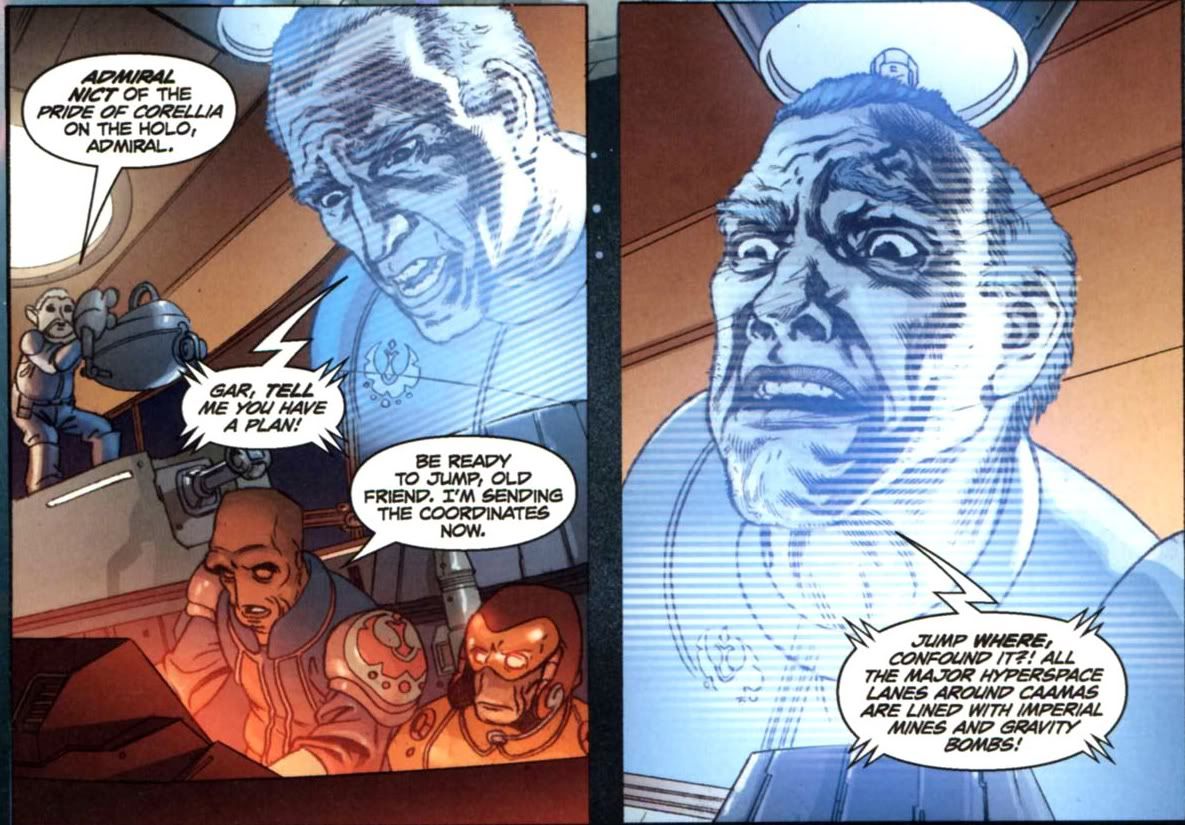
Those are the hyperspace lanes. They could be small enough to warrant upkeep and clearing, and it seems you could apply mining or intercepting.