Well, I don't know about
literal pajamas, but I think you're right about that not being a Starfleet uniform. The seams don't really line up right, do they? Actually, it looks like it might be something like the civilian jumpsuit as seen in Time's Arrow:
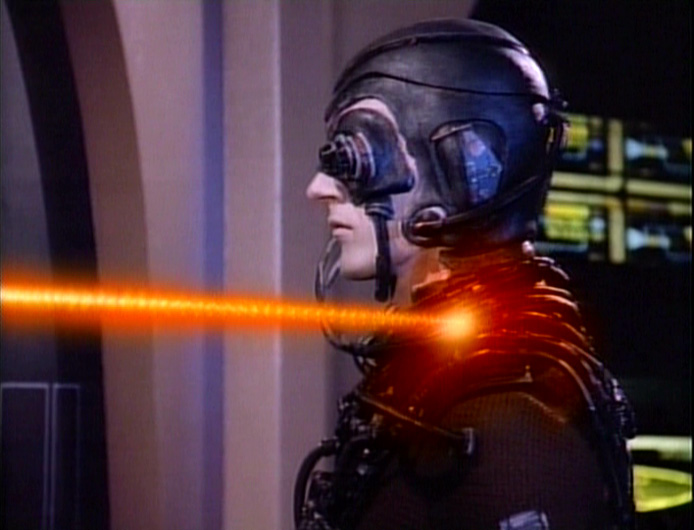
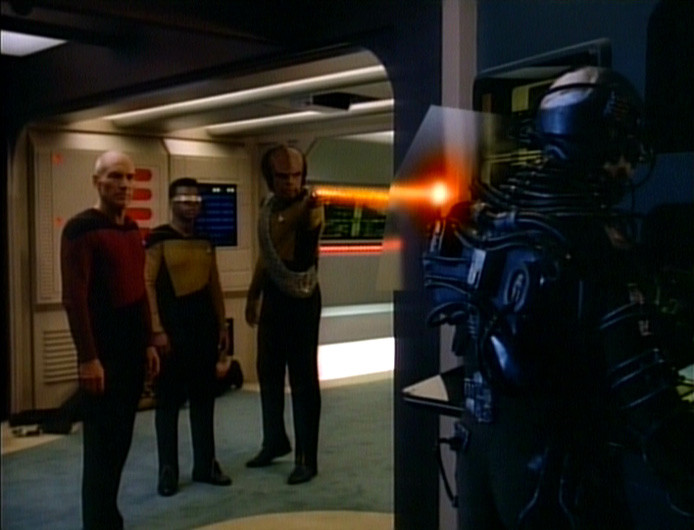
link. The scientists in "Who Watches the Watchers" appear to wear this as well. It would be a shame if they provided inferior protective garments to non-Starfleet personnel, who would seem to be just as much at risk to environmental hazards as a crewman operating a console. However, it only serves to validate the reason I brought it up in the first place. Specifically, that a simply clothed human was subjected to a beam that heated an unfamiliar material in excess of 2314 degrees, and yet he was still very much intact, looking rather like he had been subjected to a blow torch. We have come full circle to the original point I was making, that the rather common (and deadly) medium level burn and "kill" settings on phasers and disruptors compare favorably with typical blaster bolts.
Nope. Those rings are a fairly common effect in early TNG, for a variety of weapons, on a variety of settings, against a variety of targets.
http://tng.trekcore.com/gallery/albums/ ... ort184.jpg
http://tng.trekcore.com/hd/albums/1x16/ ... hd_299.jpg
http://tng.trekcore.com/gallery/albums/ ... ory196.jpg
http://tng.trekcore.com/hd/albums/1x20/ ... hd_363.jpg
http://tng.trekcore.com/gallery/albums/ ... ory200.jpg
http://tng.trekcore.com/hd/albums/1x20/ ... hd_378.jpg
http://tng.trekcore.com/hd/albums/1x20/ ... hd_384.jpg
Further, the details given are rather specific, the adrenal glands where stimulated, generating "strength and resistance." More than just adrenaline may have been at work, but the implication is clearly a tweaking of the normal human body, not exotic bio-shields, that’s the Borg's playground.
Borg learning.
Borg shielding.
B) TNG: "The Vengeance Factor" features someone who was altered at least at the sub-celular level in undefined ways to be an assassin, and the primary weapon was a microvirus.. What was done to her was left undefined, but we know she went 50 years without aging.
This is more interesting than simple adrenaline, but it is still just a tweak to how her body functioned, it's not as though her skin became armor. The limited aging factor leads me to think it was a form of overdriven healing or regeneration. The second shot definitely hurt her, it just failed to immediately terminate the functionality of her organic machinery, so to speak.
2) There is actual an episode where Spock nearly dies do to radiation poisoning caused by being too close to an object that was made to disappear.
An interesting reference, though I fail to see its pertinence here.
3) Star Trek has a tendency to give low gigawatt range numbers for type 3 and 4
TNG: Who Watches The Watchers
LAFORGE: We've finished replicating the parts they'll need, but what I don't understand is why a three man station would need a reactor capable of producing four point two gigawatts.
RIKER: Enough to power a small phaser bank, a subspace relay station, or
LAFORGE: A hologram generator. Oh, a duck blind. Right. They're anthropologists.
DS9: Return To Grace
KIRA: This is a standard issue, Cardassian phase-disruptor rifle. It has a four point seven megajoule power capacity, three millisecond recharge two beam settings.
Nope. A type 3 phaser is not a type 4 phaser. The episode TNG: Who Watches The Watchers specifically references a "small phaser
bank," this indicates a vehicle mounted unit, like may be found on a runabout or shuttle at the
smallest. As for the Cardassian phase-disruptor, we
can get a final number of roughly 1.5 gigawatts from the numbers given, but we can arrive at many other numbers too. Just as easily could we take this to mean that the weapon's total power capacity equals only 4.7 MJ. Given what these weapons can do however, that seems too low, and other references, such as TNG episode "The Mind's Eye" debunk such an interpretation. That’s simple enough. To draw a reference to contemporary firearms, those numbers probably reference the energy that can be "chambered" while a new "round" can be "loaded" to fire in just three milliseconds. How fast is the discharge rate though? Assuming a simultaneous discharge rate equal or less than the three millisecond recharge would indeed give us a total of roughly 1.5 GW, but that is the absolute high end limit, not a hard specification. Fair enough, but it's quite possible to arrive at a lower number depending on how quickly this 4.7 MJ is released.
Gigawatt level hand weapons also strike me as being too high, and again further evidence supports this. Your own reference here is a good indicator, given that you can power a "small phaser bank" one would normally find mounted on a vehicle with 4.2 GW, and considering further that shuttles and runabouts are
not particularly threatened by hand phasers, it’s a pretty good bet that the power ratings of most light infantry weapons lie somewhere south of the gigawatt range. An extra tidbit to consider is from the rest of Kira's dialog comparing the Cardassian weapon to its Federation counterpart. While she describes the Cardassian unit as having a three millisecond recharge rate, she gives no such specification for the phaser. She does however, state that it has "autonomous recharge." This seems to indicate that the Cardassian unit does not recharge while firing, while the Federation phaser is capable of firing through a live feed from the power cell. At the opposite end of the 1.5 GW pulsing stream interpretation, we could take this to mean that the Cardassian phase-disruptor has a maximum of 4.7 MJ of energy available in a single shot before the operator must stop firing while the unit "chambers a new round" so to speak. What's the longest duration beam we've seen from a Cardassian weapon? I don't recall, but I'd say this interpretation would put the weapon's effective output below the 10 MW range at any rate.
Unsatisfied? There's more. Another instance where power figures are given for a rifle is in VOY S4:E17 "Retrospect." The thoron rifle sampled for purchase to supplement Voyager's arsenal was stated to have an even more impressive sounding terawatt power source, and an even quicker four microsecond recharge. Nice, except we see the weapon emits pulsed beams, not a continuous stream. That puts the individual pulses at about 4 MJ. The weapon has an impressive rate of fire though, for not emitting a continuous stream. We only see it fired in 3 round bursts, but judging how quickly they are released, and assuming in can handle sustained fire, I would guess it could emit somewhere around 10-15 rounds per second (600-900 RPM), comparable to a contemporary SMG. This would put its effective destructive
output in the 40-60 MW range.
More? Let's take another look at light anti-vehicle weapons. In the DS9 S1:E13 "Battle Lines" we see a fully shielded runabout struck by a single weapon burst from a defensive satellite. Just prior to the attack, Kira says
"Reading a significant energy build-up in the satellite. Six hundred megawatts, nine hundred, it's firing." It takes roughly 6 seconds between the time she begins reading the energy build-up until they fire. Let’s ignore the 600 MW figure, it may have already had a partial charge when it started anyway, and let’s just go with the 900 MW figure for the full 6 seconds. That gives us a 5.4 GJ total accumulated charge, about what your earlier 4.2 GW generator could produce for a "small phaser bank" in under 1.3 seconds. This burst however, brought the runabout's shields completely down, significantly scorched the hull, and knocked out a number of systems, causing the vessel to crash. That sounds like something
significantly more powerful than a phaser rifle.
Returning again to hand weapons, there is one other notable example were specific numbers are given. In ENT S2:E23 "Regeneration," an early phase pistol is being modified, and the dialogue indicates that the weapon is boosted "another 5 MJ," before final adjustment supplies the weapon with an additional 10 MJ of power beyond an undisclosed baseline. It’s rather vague, but judging by the dialogue, the pistol may have started with about 5 or 10 MJ. At any rate, the final "supercharged" version appears to have been using around 15-20 MJ. So, clearly the 24th century phasers must be drastically more powerful, right? Well, yes, and no. For one thing, we again receive a power figure in joules instead of watts. Given that Reed later says that the new, improved pistol "may take a few seconds to recharge after each shot," we again seem to be looking at the amount of energy that is "chambered," and available to fire, rather than a clearly stated output. Furthermore, while the phaser weapons found 200 years later would obviously be superior, "superior" is a relative thing.
Take for instance, the rifles found roughly 200 years prior to our time, during the Napoleonic Wars. Rifles were still slowly phasing out older muskets at the time, much the way the phase pistol was replacing EM pistols. These early 19th century weapons were capable of firing their projectiles with over a kilojoule of muzzle energy. While modern military firearms are obviously
far superior to these antiques, contemporary carbines typically have measured ballistic energies of about 1.5-2 kilojoules, only about double that of the early rifles, and roughly equal to some of the more potent muskets. The point being that the existence of low megajoule rated hand weapons in 22nd century Trek does not provide solid evidence for a jump to gigajoule level hand weapons in the 24th century.
The numbers match up, and they seem to indicate light anti-vehicle weapons operating in the low gigawatt range, while
hand weapons are indicated to be in the low to mid megawatt range. At least, for whatever dialogue based power figures are worth. Outside of just how much the NDF portion of such weaponry does, we have perhaps seen enough explosions and glowing hot rocks to support numbers larger than "only" a few megawatts for a power ceiling, but I can think of nothing that directly supports gigawatt level small arms.
Now, having gone through all this rigmarole, how exactly did we get here? I don't think anyone here seriously thinks that storm trooper armor is going to have any significant impact on the effectiveness of phasers or disruptors, as the title of this thread clearly indicates is the question. Other than a loose connection to this thread:
10 UFP foot soldier verse 10 Stromtrooper, the only point in question seems to be "how much can a phaser overkill a storm trooper?" Normal blasters already do an adequate job, and you can't kill a storm trooper twice. It's already been stated that phasers are engineered to reduce collateral damage, so we're not looking at big, overpowered beams cutting through swaths of troopers at once either. The only real difference I can see with an engagement between storm troopers and a force equipped with phasers is that the number of wounded, surviving storm troopers would drop from almost zero to perhaps absolutely zero, and you might leave a tidier battleground by cranking the phaser to 16 and vaporizing everyone. Other than that, any firefight that may occur would probably look a lot like any previously seen in either franchise.